This is one of many interviews conducted with retired members of the Royal Canadian Mounted Police, Marine Division. This particular interview was conducted by George Savage on May 30, 2016.
GEORGE HECTOR DAWE
Hector was born at Coley’s Point, Conception Bay, Newfoundland in 1934. He explained it this way:
“In 1934, five (5) years before World War II, my parents were very protective of me when I was young and I was adventuresome and wanted to get going. I don’t know if that stems from my namesake or what. Two predecessors were named Hector. The first one was washed overboard on the Grand Banks. He was my father’s uncle and at the time, he was nineteen. The next one was my father’s brother named Hector and he died in Boston. He was married with two children and he died at the age of thirty, probably from a heart attack. I don’t know for certain. Anyway, they decided to call me Hector. I didn’t think I had a very long life ahead of me.”
When asked what type of work he did prior to joining the RCMP, he replied, “I graduated from high school, Grade 11. I was sixteen and I wanted to get going. My father wanted to set me up in a corner store. The only mentor I knew who had a corner store in the area was a man who didn’t have much ambition. Most of the day he read a book laying out with his head on a bag of flour on top of the counter. Kids went in there and bought candy and stuff like that so, instead, I decided to work elsewhere around home for the next two years”.
“My father worked at a general cargo facility there and he was the foreman. I worked there for a while and then I did longshoreman work for about two years. Eventually I decided I wanted to get away so I took a commercial course in St. John’s, a two and a half hour drive away. I lived there for ten months and then I got out of there. Then I worked at a Royal Bank. That wasn’t what I really wanted.”
“Next, I worked on a Department of Fisheries research vessel. I did that for about three years and eventually I got over being sea sick. I applied at the RCMP Headquarters in St. John’s. I was told that I would be accepted in the Marine Division but was also told I should have applied for the Land Force. I told them I was going to come back and try for the Regular Force. A year went by and nothing changed so I went back to Marine Division and reapplied there.”
“After work one day, I stopped in to see if there was any word and the Staff Sergeant told me that I could be on a train that afternoon if I was ready to go. This was ten o’clock in the morning so I rushed to the bank, closed out my account, called my parents to meet me in Whitburn and bring the clothing I would need and that was it.”
“I joined as a Special Constable, Reg. # S-11074 and later became a Marine member, Reg. # M-109 and when the Marine Division disbanded, I was issued Reg. # 24718.”
“I took the ‘Newfie Bullet’ and caught the old coastal passenger ferry and then I caught the train in North Sydney to go to Halifax. When I got there, a uniformed member by the door told me who he was and he took me down to Marine Division. The next morning, I saw the C.O. of Marine Sub/Division and he told me what to expect and what not to expect. I was issued brown khakis, sea dress which was like a battle dress tunic, pants that fit to suit and a forge cap.”
“It was kind of regimental around there even for a ship compared to the ones I was on. Every time you went to eat or even if you broke for ‘stand easy’ or coffee break, you had to take the top of your coveralls down. You weren’t allowed in the eating mess with coveralls on. This was in Marine Division and I thought, gee, I was getting worn out changing clothes. That was on the ‘French’, a ‘Depot’ ship. It was just a barracks ship, tied up and it didn’t move.”
“I was in for a year before I went to Ottawa for training. We trained for six weeks, no equitation. It was mostly drill and PT and half of it was to do with Federal Statutes and that sort of thing. It was about the Acts we were going to be enforcing.”
“On one occasion there were four of us who were discussing something at lunch time and we missed parade after lunch. We arrived there 30 seconds late and the Sgt/Major said ‘I will see you after PT at four o’clock. I don’t remember his name but he was right on the bit. This was in February and it was minus 25. To top it off, Corporal Emmit was one of the four guys. Anyway, four o’clock came and I went to the Sgt/Major’s office. His office was about a tenth of a kilometer away and we were in our PT shorts. He gave us a dressing down and the only thing that saved our skins was that Corporal Emmit’s father knew the Commissioner. That was the worst thing that happened in training.”
“The training took place in Rockcliffe and it was a long way to town. We would take a bus or sometimes we had to walk. Walking back, two chicks in a car picked us up. I guess we were not the only ones.”
“There were thirty-two in our troop. I thought training was great. Learning was a bit rugged at first but by the time the six weeks were up, I was in great shape. We ate very well, lots of food. The Musical Ride was there with their horses, at that time. There were three other troops there with us and they were taking the Musical Ride. There was nothing in training that I disliked. I was having a grand time.”
“Graduation was not a big deal. We went through drill and that night we had a party and all instructors were invited. The guys got feeling good and said what they thought of the instructors and the instructors told us what we were like, all very cordial. It was worthwhile.”
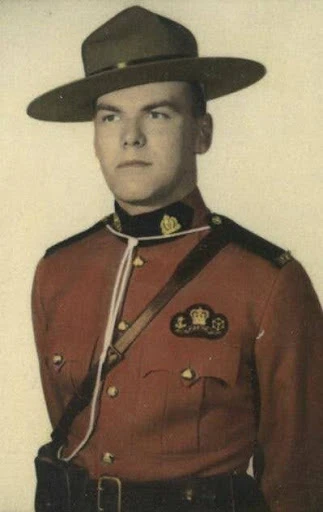
“I had my red serge at that point for about six months but I didn’t wear it much. I had my picture taken in it and sent it to my parents so they would have something to look at. There was no red serge pass-out.”
When asked where he was posted from training, he responded, “I went back to the ‘Irvine’”.
When asked where he went next, he replied, “We were seconded to escorting the Royal Yacht ‘Britannia’ and that is the first time I wore the red serge quite a bit. We went to the Great Lakes and it took about six weeks. The St. Lawrence Seaway officially opened then and we got to Thunder Bay and Chicago. We were on the ‘Irvine’ for the tour.”
“I was on the ‘Irvine’ for two years and then I got posted to a small boat in “B” Division, Harbour Breton, Newfoundland. The ‘Acadian’ was a sixty-five-footer, a Sergeant in charge, a Corporal, an Engineer and two seamen. I was there for three years. We were mainly transportation for the detachments around to the isolated communities. We didn’t actually do a lot of police work. There was no enforcement of the Canada Shipping Act at that time. There was no real enforcement until a vessel sunk one night with three or four aboard. They had no life saving equipment. I think there was an agreement at that time with the Newfoundland Government that we would not enforce but would educate and from then on it changed. We were writing tickets and so on but not at the time I was in Harbour Breton.”
When asked if they performed other duties, Hector replied, “We transported people to hospital. We were an ambulance service. We never delivered a baby but came close at times. We had all kinds of maternity cases and in the spring had a bunch of mental patients and could always count on a dozen or so in the isolated communities. Winter got to them. It could be stressful at times.”
“The main purpose for being there was to check on contraband coming from Miquelon because that was the side of the island that Harbour Breton was on. The N.C.O. i/c was not all that geared about it. He thought it was a way of life there. The detachment guys were quite keen on it and I worked quite a bit with them. I don’t think it was a priority with the master of the vessel. I was still a Special Constable at the time. While I was in Harbour Breton, I changed over to Marine Constable. That would have been in 1961 or 1962. That is when I got my Marine Reg # M-109.”
When asked when he got married, Hector responded, “I met Shirley before I went to Newfoundland. It was just a casual meeting and the relationship grew and we would spend our summer holidays together and a couple of times I came to Halifax for a boat re-fit. The waiting period of five years before you could get married had just been lifted. Six months later, I was married.”
“It was around that time that Marine Division was being fazed out. I was told by the Staffing Officer to forget about my Marine service and try to adapt. I had thirteen years’ service when I went to Halifax Detachment in 1970. My detachment area ran from St. Margaret’s Bay right up to the airport, Sambro and Peggy’s Cove and everything in between. I was posted there for a year.”
“At that time, an opening appeared with the Migratory Bird position. I applied for it, was interviewed and got the position. It was the best job that I ever had. I worked long hours and I knew Bill McKay and Jack Himmelman who were also in Migratory Birds. I knew them from Marine Division.”
“I would have stayed for the rest of my service. I spent a lot of time on the road from Cape Breton to Cape Sable Island. Cape Sable was the worst place. They hunted down there year around. We had one guy there that we got three times for poaching before his first one went to court. I was promoted to Corporal there. Then an opening came on a new ship, the ‘Fort MacLeod’ in Halifax and I was the only former Marine that was available. Everyone else had been dispersed to other places, so I ended up in charge.”
“They had a lot of the smaller boats. When they disbanded the Marine Division, they got rid of the larger vessels. The sixty-five footers were still going. There was one in Sydney and another in Yarmouth. Those ships went on for another five or six years.”
“Fourteen months after being promoted to Corporal, I was promoted to Sergeant on board the ‘Standoff’. I did that for three years. At the end of three years, they decided to get rid of the boat. It would have gone earlier but the Olympics were coming to Montreal in 1976. They decided to send the Fort MacLeod to do a dry run in the summer. I took my wife and son and rented a camper trailer in a Lake Ontario park on the waterfront in Kingston for six weeks. It was a holiday for them and I enjoyed it. When I got back to Halifax, I had no job but I was still assigned to Halifax.”
When asked where he did work, Hector replied, “I worked in Customs and Excise and that is when I interviewed for a job in Newfoundland. In 1973, the Force decided to celebrate by buildin